You need coverage now, but every quote feels risky
The email from a client asks for a certificate by end of day, the landlord wants proof before keys, or a contract won’t countersign without specific limits. So quotes start coming in fast—and they rarely line up. One carrier is cheap but vague on exclusions. Another looks “complete” until the deductible and sublimits show up. The pressure isn’t just price; it’s the fear of buying something that won’t respond when a claim hits cash flow.
At this point, the risk is comparing headlines instead of the deal. A low first-year premium can hide tighter terms, weaker endorsements, or a renewal jump you can’t absorb. The goal in the next steps is to make the quotes measurable before any company name feels “safe.”
Build a scorecard before you look at company names
Before the carrier logos start influencing the decision, it helps to pin down what “acceptable” means for your business this quarter. Time is the first constraint: if the certificate is due today, the scorecard has to be fast enough to use, but strict enough to stop a bad policy from slipping through. I’ve seen owners get anchored by the lowest premium, then realize later the quote assumed a higher deductible than they can comfortably fund, or excluded the exact job site requirement the contract spelled out.
In practice, a one-page grid works. Put the must-haves at the top: limits by line (GL, property, auto, WC), deductible you can actually pay within 48 hours, and any contractual requirements (additional insured, waiver of subrogation, primary/noncontributory). Then add comparables that affect cash flow: sublimits for theft/water damage, business income waiting period, whether defense costs are inside limits, and the cancellation/nonrenewal terms. Score each quote “pass/flag/fail” first; only then compare price.
Pricing: stable renewals versus low first-year quotes
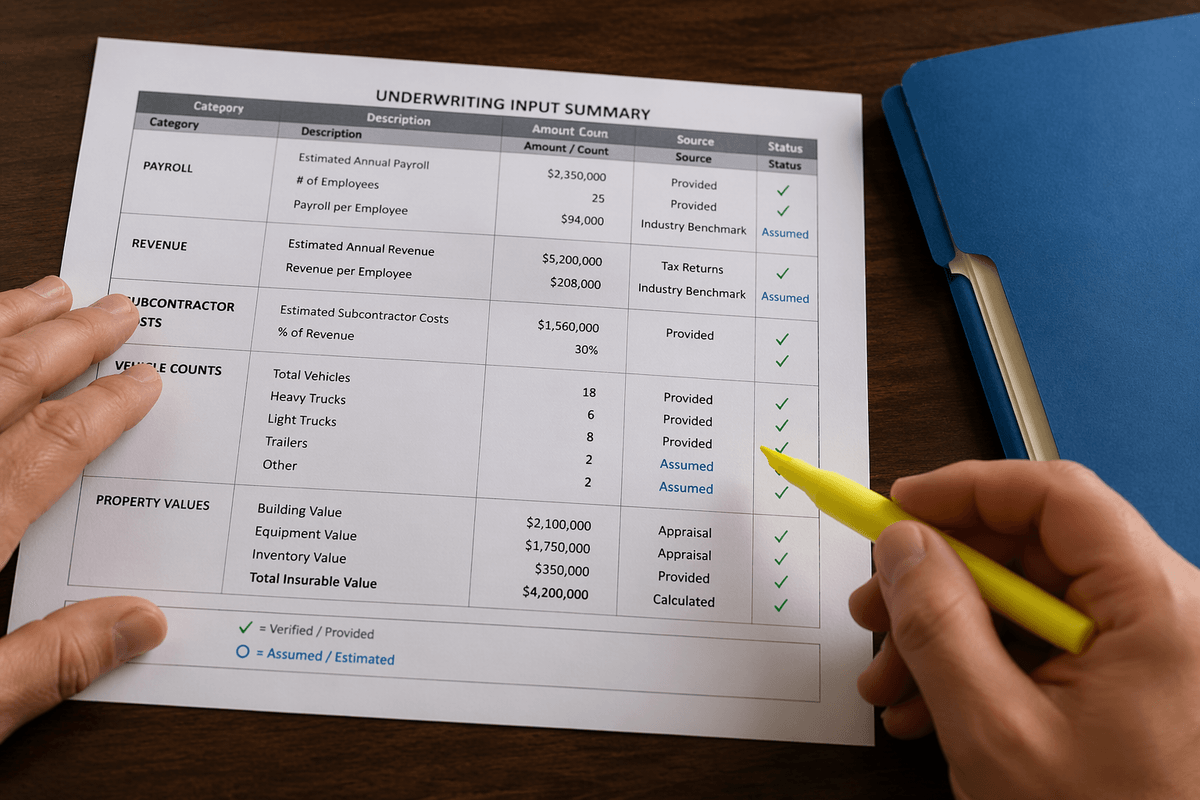
Once the scorecard starts spitting out a few “passes,” the cheapest number on the page still tries to take over. The catch is timing: you’re buying a year of coverage, but you’re also buying next year’s renewal conversation. If cash flow is tight, a low first-year quote can feel like the only workable answer—even when it’s built on a higher deductible, a narrower class code, or optimistic payroll/revenue assumptions that will get corrected later.
To keep pricing comparable, push each option into the same frame. Ask for the full rating basis in writing (payroll, sales, subcontractor cost, vehicle counts, property values) and note what was assumed versus verified. Then look for “swing factors” that drive renewal shock: big schedule credits that can disappear, new-business discounts, claims-free credits, or a policy written with minimal prior-loss detail. If one carrier is 25% lower, don’t treat it as a win yet—treat it as a question you haven’t priced out.
The practical test is budget resilience. Run a simple scenario: if the premium rises 15–25% at renewal, can you absorb it without cutting staff hours or skipping maintenance? If not, stable renewals are worth paying for—especially when the carrier’s quote is built on conservative, documented exposures that won’t get “trued up” when you’re already committed.
Coverage reality: endorsements that separate good from cheap
When the pricing starts to look “reasonable,” the next surprise usually lives in the endorsements—not the declarations page. Two general liability quotes can show the same $1M/$2M limits and still behave very differently once a claim or contract dispute shows up. The constraint here is paperwork speed: you may need to bind today, but endorsements are where cheap coverage turns into an expensive gap.
So I treat endorsements as the real product. Confirm whether additional insured status is automatic or scheduled, and whether it includes primary/noncontributory wording (many contracts require it). Check if waiver of subrogation can be added across lines or only by exception. Look for exclusions that quietly reshape the business: subcontractor limitations, height/depth restrictions, action-over exclusions, professional/pollution carve-outs, and any “designated ongoing operations” language that narrows completed-ops.
On property and business income, endorsements decide whether small losses stay small. Ask about theft sublimits (especially for tools), water damage limits, equipment breakdown, ordinance or law, and whether business income is actual loss sustained with a workable waiting period. If one quote can’t supply the endorsements in writing before binding, score it as a flag—because that uncertainty is exactly what shows up at claim time.
Claims handling: what to verify before you’re stressed

Even with the right endorsements, the real test is whether the carrier can move a claim without turning it into a second job. The constraint is usually time: payroll still runs, customers still expect delivery, and a property loss can force decisions in 48 hours. Before you bind, ask who actually handles your claims (in-house adjusters versus a third-party administrator) and get the claims reporting path in writing—phone, portal, after-hours, and what counts as “notice” under the policy.
Then verify the frictions that create cash-flow pain. For liability, confirm whether defense is assigned immediately and whether the carrier uses panel counsel, plus any consent-to-settle expectations. For property, ask how they pay (ACV versus RCV timing), what documentation triggers partial payments, and whether they’ll advance funds for mitigation. If they can’t explain authority levels, escalation, and typical cycle times, score it as a flag—because that ambiguity is what you inherit when you’re stressed.
Service fit: certificates, audits, and everyday admin burden
After the claims questions, the next friction shows up in the boring stuff that still costs money: getting certificates out fast, keeping endorsements current, and surviving the audit without a surprise bill. A carrier can look strong on paper and still slow the business down if every certificate request takes two days, or if additional insured wording requires back-and-forth that your client won’t wait for. The constraint is usually timing—jobs start on Monday even when insurance admin is a Friday afternoon scramble.
So I score “service fit” like a workflow, not a promise. Ask how certificates are issued (self-serve portal, agent-only, or carrier-only), whether you can batch holders, and how quickly special wording gets turned. Then look ahead to audits: confirm how they collect payroll/revenue (portal uploads versus spreadsheets), how often they audit, and whether they accept job-cost reports or certified financials. If the answer is “we’ll figure it out later,” expect later to mean extra hours and a potentially sharp true-up.
A practical shortlist: match insurer strengths to your risk
By now, the quotes that survived your scorecard should feel fewer, not “better.” The last constraint is decision time: you still need a carrier that can bind cleanly, issue the certificate today, and not create a renewal crisis in nine months. So instead of hunting for a single winner, build a shortlist with roles—each option anchored to the risk it handles best.
If your exposure is contract-heavy (additional insured, waivers, tight wording), keep the carrier that consistently produces endorsements fast and without exceptions. If property downtime would hurt cash flow, prioritize the option with clearer business income terms and predictable claims payment mechanics. If audits have burned you before, favor the carrier with transparent audit rules and a process you can actually maintain. Two strong fits beat one cheap unknown.