The week you finally start a rental or loan application, a routine check shows your score slipped. Nothing dramatic changed: paychecks still hit, autopay still ran, and there were no late payments. But a travel charge posted, the grocery run landed on the same card, and the balance sat higher than usual for a few days. That’s enough to feel risky when a landlord is pulling your credit or a lender is pricing a rate. The frustrating part is the timing—you can do everything “responsibly” and still look stretched on paper right when someone is evaluating you.
When the window is tight, the question isn’t whether you can pay. It’s whether your balances will be reported at a level that makes you look higher risk than you are, and whether you have time to influence what gets captured.
Why on-time payments don’t prevent utilization swings
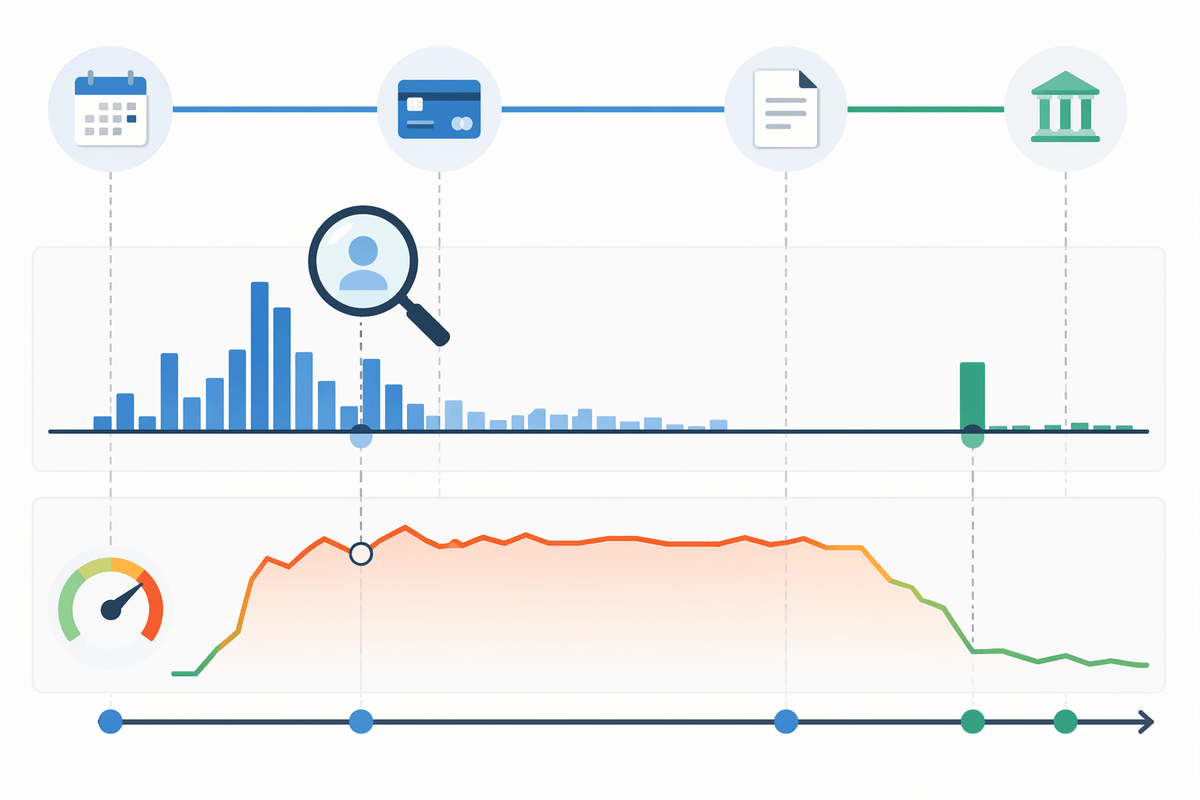
Autopay is doing its job, but it’s solving a different problem. Paying on time protects your payment history; it doesn’t keep your balances from looking temporarily high. If you spend $2,000 on a card with a $5,000 limit, then pay it off in full a few weeks later, there’s still a stretch where the account shows 40% used. If that stretch lines up with a credit check, it can read like stress even though it’s just normal spending and a normal payoff cycle.
The swing gets worse when spending clusters. A plane ticket, insurance renewal, or back-to-school run can land early in the cycle, while the due date is still far away. Meanwhile the issuer is adding new purchases daily, so the “current balance” can stay elevated even after a payment posts. None of this violates good habits, but it does create a mismatch: you’re behaving like someone who pays in full, while the snapshot someone else sees can resemble someone carrying debt close to their limit.
What credit utilization rate measures in practice
Utilization is basically a ratio: the balance that gets counted divided by the credit limit that’s available. Scoring models look at it two ways at once: per-card and overall. If one card reports $2,000 on a $5,000 limit, that card is at 40% even if your total across all cards is modest. Overall utilization adds up the reported balances across revolving accounts and compares them to the sum of their limits. That’s why spreading charges across two cards can change the math without changing your spending—$2,000 on one $5,000 card is 40%, but $2,000 split across two $5,000 cards is 20% overall, with no single card looking strained.
In practice, the stress comes from uneven limits and real-life constraints. A card with a $1,500 limit can “look maxed” after a normal month of commuting, groceries, and one annual bill, while a $10,000-limit card barely moves. When an application is days away, that per-card spike can matter more than your intention to pay it off in full.
The statement date snapshot that gets reported
The part that usually catches people is that the number getting scored isn’t your “today” balance. It’s the balance shown on the statement closing date, because that’s the point many issuers use to report to the credit bureaus. So even if you pay in full every month, a heavy-spend week that happens to land right before the statement cuts can become the month’s reported balance. If the due date is two or three weeks later, you can be “safe” operationally and still look highly utilized on paper.
That timing gap is where the score dip tends to appear. A payment made after the statement closes won’t change what was captured for that cycle, even though it reduces what you actually owe. Some issuers report on a different schedule or may update again after a payoff, but you can’t count on that when a rental or loan pull is imminent. What you can control is whether your balance is low before the statement date, not just before the due date.
When one card looks maxed out on paper
What tends to trigger the “maxed out” feeling isn’t your total spending, it’s how the utilization math punishes the tightest limit. A $900 statement balance on a $1,000-limit card reports as 90% on that one account, even if you have another card with a $9,000 limit sitting near zero. Overall utilization might look fine, but the file also contains a single revolving line that appears strained, and that can be the detail a scoring model reacts to.
This shows up most with a “category” card that gets all the groceries or travel, or a newer card that hasn’t earned a higher limit yet. If a large charge posts right before the statement closes, the reported snapshot can make it look like you’re leaning on that card for credit. The constraint is simple: you can’t fix it after the statement cuts, and shifting the payment to the due date doesn’t change the picture that got recorded.
Choosing safer utilization targets under uncertainty
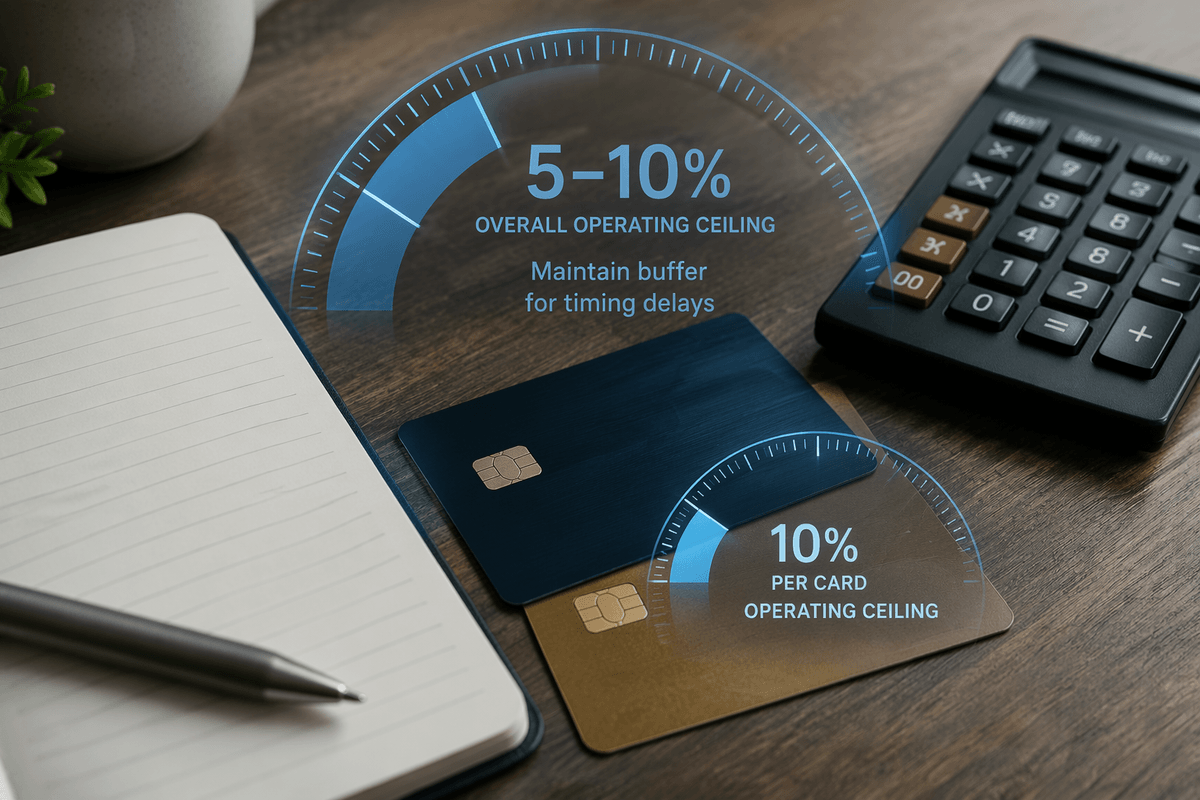
Once you accept that you can’t perfectly time every posting and every statement cut, the practical move is picking utilization targets that tolerate noise. A common “fine most months” number can still backfire if a large purchase lands two days before the statement closes or if a payment takes an extra day to clear. For an upcoming application, it’s usually safer to treat 10% as an operating ceiling on any single card and aim for roughly 5–10% overall, not because higher ratios are “bad,” but because they leave room for timing slippage.
The constraint is that limits aren’t evenly distributed. If one card has a $1,000 limit, a $200–$300 statement balance already puts it in the 20–30% range. Under uncertainty, the target becomes “keep the small-limit card quiet,” even if that means shifting routine spend to a higher-limit card for one or two cycles.
Simple moves that lower utilization risk quickly
At this point it’s less about “optimizing” and more about buying predictability before the pull. The fastest lever is a mid-cycle payment: push the balance down a few days before the statement closes so the reported snapshot is smaller, even if you still pay the rest by the due date. If a payment takes a day to post, send it earlier than feels necessary.
Next, stop feeding the tight-limit card for one cycle. Move recurring charges to the highest-limit card, or split a large purchase across cards so no single line reports hot. If you can, ask for a credit limit increase well ahead of the application; if it triggers a hard inquiry or the issuer says no, skip it and stick with earlier payments instead.








![Learn to Invest by Yourself [Beat the Market With Investing Basics]](static/image/2026/07/14/0c228cd1-fbac-42e5-9480-a2074601a70d.png)